


White Paper: QDD Furuta Pendulum and AUGUR digital twin
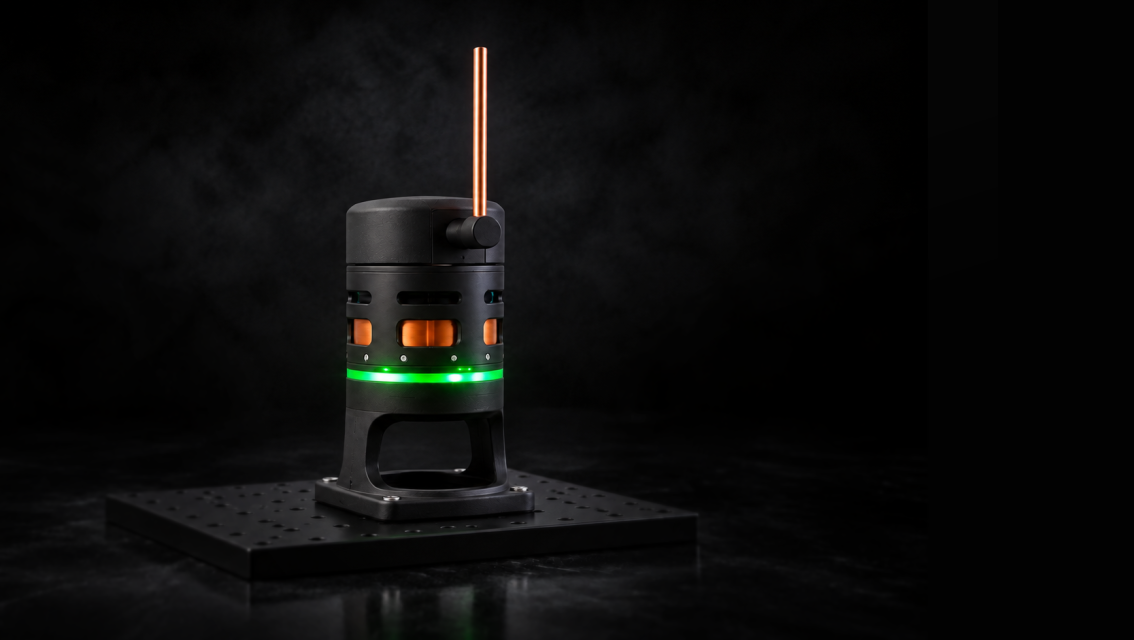
This white paper introduces a QDD Furuta pendulum platform built around a PULSE98 actuator. Rather than reducing actuation to an idealized motor, the product uses a complete actuator with a 5:1 transmission, bringing a practical robotics architecture into a compact teaching platform. The associated AUGUR digital twin makes that architecture straightforward to perform classical, optimal or predictive control, reinforcement learning and identification tasks, enabling students and researchers to move confidently from simulation to physical hardware.
1. Introduction
The Furuta pendulum has long been one of the clearest ways to teach nonlinear control. Its appeal is obvious: the system is compact, analytically approachable, and rich enough to exhibit swing-up, stabilization, and balance under uncertainty. For that reason, it remains a staple in laboratories and classrooms. In many educational setups, the drive stage is direct, the transmission path is short, and the actuator behaves almost like an ideal torque source. Students learn the simplest equations, but not always the friction, backlash, compliance, and reflected inertia that dominate real robotic hardware.
PULSAR’s Furuta pendulum takes a different position. Instead of reducing the setup to a bare motor and an idealized load, it uses the PULSE98 as a complete actuator with a 5:1 transmission. The system remains responsive and backdrivable, while giving students access to the actuator-level dynamics that appear in practical robotics. With AUGUR, those dynamics can be modeled, identified, and incorporated into controller design. The result is an accessible and more representative training ground for modern robotics.
2. Why the Classical Benchmark Is Not Enough
A direct-drive Furuta pendulum is elegant because it minimizes the number of unknowns. The motor is coupled almost directly to the rotary arm, so the control problem focuses on the inverted-pendulum dynamics themselves. That simplicity is useful, especially when the goal is to explain core concepts such as state feedback, swing-up energy shaping, or linearization around the upright equilibrium. But it also creates a strong separation between the teaching example and the machines that are used in real robots, where the actuation chain is typically a complete system with a gearbox included rather than an ideal source of torque.
Gears or belts introduce measurable friction, compliance, saturation, and reflected inertia through a finite transmission ratio. These effects shape observability, bandwidth, and stability margins, but at a low reduction ratio they remain intuitive to explore and straightforward to identify. A controller developed only on a direct-drive benchmark may overlook this actuator-level behavior. For that reason, a Furuta platform with a transmission is more than a variation; it is a stronger proxy for the machines that students will later need to control.
Table 1. Direct-drive Furuta versus the QDD Furuta.
| Aspect | Direct-drive Furuta | PULSE98 + 5:1 transmission Furuta |
|---|---|---|
| Actuation path | Motor couples directly to the arm. | Complete PULSE98 actuator drives the arm through its 5:1 reduction. |
| Actuator behavior | Idealized motor-to-load path with minimal drivetrain behavior. | Measurable and realistic friction, backlash, compliance, and reflected inertia. |
| Control feel | Simplified and transparent. | Responsive, fairly backdrivable, and transmission-aware. |
| Benchmark value | Idealized/oversimplified textbook benchmarks. | Representative robotics benchmark. |
| Educational value | Core pendulum-control theory. | Core theory plus actuator modeling, identification, and sim-to-real practice. |
3. Product Architecture
The proposed device is built around three linked layers: the PULSE98 actuator and its transmission, the inverted pendulum, and the AUGUR digital twin. The PULSE98provides a complete actuation system that is used for platforms sucha as arms or exoskeletons with the 5:1 transmission already in the loop. The ratio preserves the responsiveness and backdrivability needed for control work while making actuator dynamics available for modeling, system identification, and to develop advanced model-based control techniques.
Whereas direct drive removes much of this actuator-level behavior and is therefore easier to treat as an ideal torque source, but less representative of common robotics architectures. The selected ratio keeps the dynamics accessible while exposing enough transmission behavior for meaningful modeling and system-identification exercises.
4. What the Transmission Changes in Control
The transmission adds practical actuator behavior that a simplified benchmark tends to hide. Around reversals, small effects such as backlash and friction can be observed and identified, while reflected inertia shapes the apparent load seen by the motor. At the low 5:1 ratio, these effects remain manageable, and the mechanism remains responsive and backdrivable. Rather than being obstacles, they provide measurable phenomena for modeling, compensation, and controller design.
Together, these effects make the relationship between model, actuator, and mechanism visible. A direct-drive setup closely resembles an ideal motor-to-load connection; the PULSE98 architecture retains intuitive behavior while adding the actuator dynamics present in real robots. With AUGUR, students can identify those dynamics, test their influence, and refine the model systematically. This turns a compact benchmark into a realistic modelling and control problem without sacrificing accessibility. In fact, quasi-direct drive actuators are becoming the most popular option in robotic applications due to its performance, in this way students can have a smooth introduction into this actuation technology.
The objective is not only to stabilize the pendulum, but to do so with a model that remains trustworthy across its operating range. Gain selection, state estimation, and friction compensation therefore become practical, observable parts of the exercise rather than abstract or optional refinements.
5. The Role of the AUGUR Digital Twin
The associated digital twin changes the development workflow from trial-and-error to a controlled loop of modeling, simulation, tuning, and verification. AUGUR provides a virtual representation of the complete actuator and drivetrain so that control strategies can be developed before the system is exercised on hardware. Because the PULSE98 model provides a practical starting point, system identification can focus on refining parameter values with different techniques such as Kalman or more modern techniques based on neural nets rather than building an actuator model from scratch.
In practice, the twin becomes the bridge between the mechanical design and the control design. Students can identify the actuator model, estimate friction and transmission parameters, tune swing-up gains, and study how controller behavior changes as parameter accuracy increases. They can also compare simulation against the real bench, making the gap between model and hardware a visible and teachable subject rather than a hidden source of frustration.
- Use AUGUR digital twin and sim assets provided to create a simulation environment in Mujoco.
- Tune control gains against realistic losses, saturation, and sensor behavior.
- Transfer the controller to the physical bench and compare the response.
6. Development Workflow
The intended workflow is simple to describe and powerful in practice. Work begins in simulation, where the actuator model and the pendulum dynamics are combined. A controller is then tuned around the virtual system, with the identified actuator and drivetrain dynamics represented from the outset. Once the response is acceptable, the same control structure is transferred to the physical platform. Students are given the opportunity to develop their own custom controllers and to consider practical issues such as optimization, execution order, delays, and other challenges encountered in real-world control applications.
This sequence is valuable because it teaches process, not just outcome. Students learn that control is not a one-shot derivation from equations to code. It is a cycle of hypothesis, simulation, measurement, revision, and re-test. The Furuta pendulum becomes a compact but realistic example of how real robotics development actually works.
7. Educational and Research Value
The educational value of this platform comes from combining clarity with practical relevance. It teaches the same core ideas as any Furuta pendulum, but does so with a complete, backdrivable actuator rather than an idealized motor. That makes it useful not only for control theory courses, but also for modelling courses, reinforcement learning courses, robotics laboratories, mechatronics programs, and graduate research projects that need a reliable way to study actuator-aware control.
For students, the platform provides an opportunity to see how a controller developed from theory can be refined systematically for hardware. For academics, it offers a repeatable testbed for comparing modeling strategies, exploring friction compensation, studying observer performance, and evaluating how much fidelity is needed in a digital twin. For both groups, the key benefit is the same: they are learning on a system that reflects practical robotics while remaining compact and approachable.
That distinction is central to the product’s vision. The value of the device is not only that it can be controlled, but that it shows how control theory translates into reliable robotic hardware.
8. Conclusion
PULSAR’s QDD Furuta pendulum goes beyond the usual direct-drive benchmark. By using a complete PULSE98 actuator with a 5:1 gear ratio, the platform preserves the responsiveness and backdrivability needed for intuitive experiments while representing the friction, reflected inertia, and transmission behavior found in real robotic systems. The result is a control problem that remains accessible and is substantially more representative.
The accompanying AUGUR digital twin makes the architecture easy to adopt. It enables simulation of the full actuation chain, supports controller tuning (or training) in a virtual environment, and helps narrow the gap between model and hardware before students or researchers reach the bench. In that sense, the product is more than a pendulum. It is a small but powerful platform for learning how to model, identify, and control advanced actuation systems under representative conditions.
That educational role is not secondary. It is the point. The device gives universities and research groups a way to train people on a system that behaves like an authentic robotic actuator, not a simplified motor. That makes it useful for teaching, experimentation, and for building the next generation of engineers who understand both the theory of control and the realities of bringing that control to hardware.
Curious to see PULSAR Ecosystem in action?
Have questions or want to explore the platform first? Get in touch with us to
learn more, and experience the digital twin and simulation assets firsthand.
Contact us